Leak testing is a critical quality control process across manufacturing industries. An undetected leak can compromise product performance, lead to costly field failures, and damage customer trust. With multiple methodologies available, selecting the right one requires careful evaluation.
Defining "Leak-Tight": What It Really Means
No component is completely leak-proof; all materials permit some degree of leakage through defects or natural diffusion. Tightness therefore cannot be defined in absolute terms, it must be defined by a leakage rate: the volume of air, gas, or liquid passing through a leak over time,or a pressure change over time at a specified pressure differential. Acceptable rates vary by application, operating pressure, temperature, and service media.
A useful principle: because gas molecules (air, helium, hydrogen) are far smaller than liquid molecules (water, oil), a component that passes an air or helium test at the appropriate pressure can generally be considered watertight or oiltight as well.
Key Factors in Method Selection
- Required leakage rate and test pressure
- Testing time and required throughput
- Component material, volume, geometry, and cleanliness
- Environmental operating conditions
- Documentation and automation requirements
- Capital investment and total cost of ownership
General rule: air and underwater methods suit standard leakage rate requirements; helium and tracer gas methods are reserved for stricter tolerances.

Underwater Leak Testing
The gas-filled specimen is submerged, and bubble formation at leak points is visually assessed.
- Ideal for: Basic detection; components that can be safely wetted
- Advantages: Simple localization, detects small leaks with sufficient observation time, unaffected by temperature or vibration
- Limitations: Requires water treatment, relies on operator judgment, difficult to quantify precisely
Air Leak Testing
Method
Ideal for
Key Trade-off
Pressure Change (A)
Small volumes, larger leak rates
Low cost, but limited resolution for very small leaks
Pressure Differential (R)
Small volumes, fast cycles
Strong resolution, but sensitive to temperature
Pressure Increase (S)
High pressure (up to 1,000 bar), fast cycles
Very capable, but mechanically complex
Closed Component (DA/DR)
Fully sealed components (electronics, watches)
Standard for waterproof goods, but longer test time
Mass Flow (M)
Large volumes (tanks, housings)
Cost-effective at scale, but needs a matched reference volume
Flow Measurement (Q)
Defined flow channels
Fastest method (under 2 sec), but higher equipment cost
Helium and Tracer Gas Testing
For leakage rates beyond conventional air testing’s capability. Helium is the standard tracer gas for its precision and short cycle times forming gas (5% hydrogen/95% nitrogen) is a cost-effective, non-flammable alternative.
- Manual Sniffing: Precise leak localization and troubleshooting; labor-intensive and best for spot-checking rather than full coverage.
- Accumulation Method: Strong for large, unstable, or hot components; unaffected by ambient conditions, but offers no leak localisation.
- Vacuum Integral Method: The most sensitive and fastest method available, ideal for the smallest leak rates and high pressures; highest investment cost, no localization.
Burst Pressure Testing
Determines the maximum pressure a component can withstand before failure.
- With Air: Best for small, sensitive components needing precise failure data. Low cost, but stores significant energy, failure can be forceful, requiring robust safety design.
- With Water/Oil: Best for large volumes or very high burst pressures. Much lower stored energy and safer at scale, but requires specialized filtration and venting infrastructure.
Method Selection at a Glance
Application Requirement
Recommended Method
Basic detection; specimen can be wetted
Underwater testing
Standard rate, small volume
Pressure Change (A)
Standard rate, fast cycle
Pressure Differential (R)
Large-volume components
Mass Flow (M)
Very high test pressure
Pressure Increase (S)
Fully sealed, no access port
Closed Component (DA/DR)
Defined flow channel
Flow Measurement (Q)
Very small/strict leak rates
Helium/tracer gas
Precise leak localization
Manual sniffing
Maximum sensitivity and speed
Vacuum integral
Determining failure pressure
Burst testing (air or water/oil)
Recommended Solution: The innomatec LTC-503
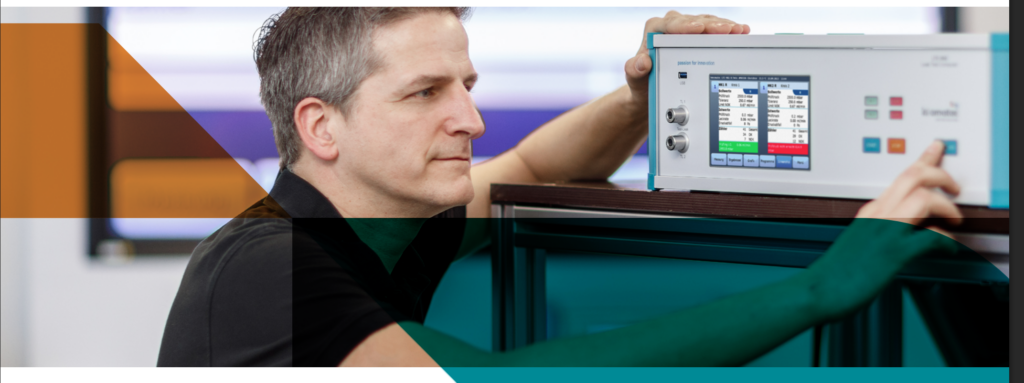
For manufacturers seeking to implement reliable, standardized leak testing without unnecessary complexity, the innomatec LTC-503 sets a new standard for entry-level leak testing. As the first system in innomatec’s next-generation leak test line, the LTC-503 combines high-performance measurement, a redesigned user interface, and industrial-grade durability, all built on more than 40 years of leak testing expertise
Why the LTC-503:
- Accurate and reliable: Detects very fine leaks down to 0.1 Pa, with a higher sensor range (DP sensor range to 300 mbar) and improved repeatability
- Unmatched flexibility for an entry-level system: Supports five distinct leak test methods in a single unit: Pressure Change (A), Pressure Differential (R), Dosing Closed Component with Pressure Change (DA), Dosing Closed Component with Pressure Difference (DR), and optional automatic Volume Determination (C)
- New, intuitive user experience: A smartphone-inspired UI on a 5″ multi-touch display simplifies navigation, program management, and test visualization, reducing training time and operator dependency
- Easy to integrate: 24VDC power supply, built-in PLC communication, and a modular design allow fast setup, commissioning, and scaling, including expandable I/O (up to 24 inputs and outputs)
- Advanced testing features: Vacuum generation, automatic test piece distribution, automatic master part testing, prefill and filling ramp options, blockage detection, and membrane testing
- Built to perform: Rated for 16 million valve cycles, with 10x lower energy consumption and a 10x longer service interval than typical entry-level systems, backed by an optional extended warranty
- Connected and supportable: Compatible with all common plant floor interfaces and protocols, with remote service, over-the-air software updates, and remote support capabilities
- Economical and fast to deploy: A cost-effective option with worldwide delivery
Ideal for machine builders balancing cost and performance, the LTC-503 reduces engineering time, covers the most common leak test needs out of the box, and delivers the measurement quality and UX that keeps customers satisfied, all in a durable, compact housing (340 x 190 x 300 mm, 8.5 kg).
Conclusion
Selecting the right leak test method ultimately comes down to matching a method’s sensitivity, speed, and cost profile to the specific demands of the application, there is no one-size-fits-all answer. As a starting point, air-based methods offer the best balance of cost and simplicity for most standard requirements, with helium or tracer gas reserved for applications where sensitivity is non-negotiable. For manufacturers looking to standardize air leak testing on a single, future-ready platform, the LTC-503 is built for exactly that purpose. Combining five test methods, industrial-grade durability, and a modern operator experience in one cost-effective system.
Ready to see the LTC-503 in action?
Click here to learn more and discover how the innomatec LTC-503 can make leak testing easy for your application!